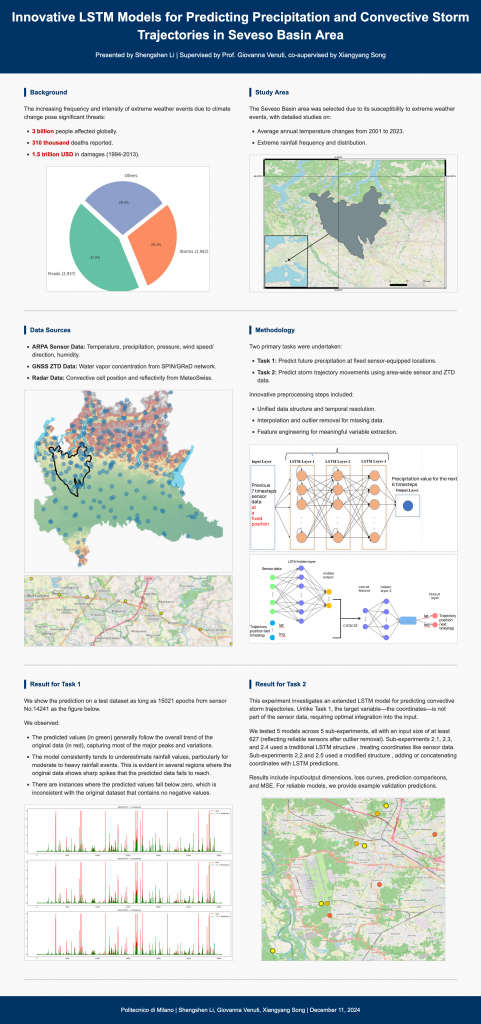
This study presents an innovative approach for predicting precipitation and convective storm trajectories by integrating Long Short-Term Memory (LSTM) networks with a Multi-Layer Perceptron (MLP) model.
Read more
Convective storms are complex atmospheric events that, especially due to their enhanced frequency with global climate change, represent an increasing risk of heavy rainfall, flash floods, and severe weather phenomena. To address the inherent challenges, this research leverages LSTM for time-series predictions of meteorological sensor data and fuses spatial coordinate information from convective storm trajectories through MLP integration. Extensive preprocessing, including missing data handling, outlier removal, and feature extraction, was applied to sensor data obtained from environmental sensors (ARPA Lombardia) and GNSS ZTD measurements, along with MeteoSwiss radar data. Our two sets of experiments focus on recursive LSTM forecasting for time-series sensor data and trajectory predictions by combining sensor inputs and spatial dynamics. The results demonstrate that the LSTM models, when complemented by an MLP for spatial information, yield accurate short-term forecasts of sensor-driven storm movements. The recursive predictions provide promising results with high precision in immediate next-step storm occurrences but reveal challenges in preserving accuracy over extended time steps. The proposed model holds significant potential for operational forecasting of both precipitation and the spatial trajectory of convective storms.